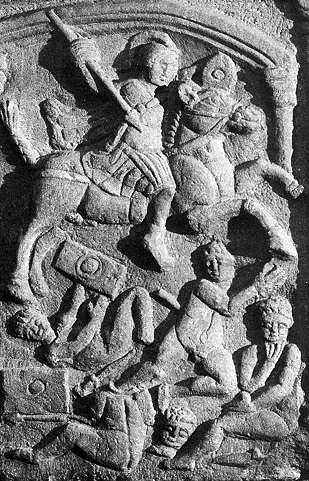
The Roman Invasions of Scotland
The Invasions Begin
The Roman invasions of what is now Scotland was a continuation of their conquest of what became England. It was made possible by the fact that it was conducted while the bulk of the Roman World was at peace. This enabled resources to be safely directed to the conquest of a peripheral area like Scotland.
The Invasions Continue
These attacks and invasions began around 80 AD under the Roman Governor Gnaeus Julius Agricola who conducted several campaigns designed to conquer Caledonia and add it to the recently conquered province of Britannia. In the years up to 84 AD Agricola conducted military invasions culminating in the Battle of Mons Graupius where he gained a major victory according to his son in Law Tacitus. Many fortifications were constructed including the legionary fortress at Inchtuthil near Perth in Perthshire. The Roman navy also conducted extensive naval operations including a circumnavigation through the Pentland Firth. Agricola was ultimately recalled to Rome and Roman commitments elsewhere ensured that their attempts at conquest were abandoned at that time.
The Later Invasions
After little recorded defeats of the Roman army the Emperor Hadrian ordered the building of the wall which bears his name in 122 AD. Twenty years later his successor Antonius Pius ordered an exceptionally brutal advance to the Forth Clyde line and the building of a defensive wall there. However less than twenty years later the Romans withdrew back to Hadrian’s Wall abandoning the other wall they had recently built. From 180 AD onwards renewed attacks in to the province culminated in the full-scale invasion by the Emperor Septimius Severus (d. 211 AD) in the years 2010-11. The invasions had a profound effect on what is now Scotland, then called Caledonia by the Romans. Chief amongst these effects was to cause the Celtic tribes above the Forth-Clyde line to increasingly coalesce. This was in an attempt to mount a more effective defence against the attacking Romans. The effect of this in turn was to lead to a more hierarchically structured society. This newly organised society was designed to combat and defeat the Roman forces who had launched repeated invasions.
The Northern Tribes
The Romans from around 300 AD onwards increasingly referred to the Northern tribes as ‘Picti.’ Meaning the painted or tattooed people. Below the Forth-Clyde line the tribes tended to cooperate with Rome, becoming allies or ‘foederati’ (federal) of the Roman people. Again this had profound consequences as culturally and socially those tribes adopted Roman customs including the eventual adoption of Christianity . This served to increasingly differentiate them from the tribes further north.
The South-East of Scotland
Of all the tribes this was particularly true of the Votadini of the south-east of Scotland . They under Roman influences began to change significantly in cultural terms from those tribes beyond the Forth-Clyde line. This process accelerated after 400 AD and through the subsequent centuries. In particular after the adoption of Christianity by the Roman Empire in the later fourth century.
The Roman Invasions of Scotland : Power Shift
From the year 300 AD onwards the balance of power increasingly shifted away from Rome. This forced the Roman forces increasingly on to the defensive. Meanwhile the processes provoked and accelerated by the Roman interventions continued apace. With the increased centralisation of these Celtic tribes continuing after Rome’s departure during the course of the early fifth century AD.