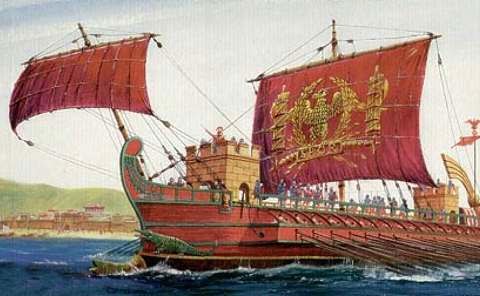
Roman Trireme
Demetrios of Tarsus
One of the most amazing stories to emerge from the Roman world was that of Demetrios of Tarsus. Known through a meeting with the Greek writer Plutarch at Delphi in Greece around 83 AD he was described as a Literature teacher. Having been ordered by the Roman authorities to undertake a naval exploration of the Western Isles of what is now Scotland. Demetrios gave a detailed description of his travels sailing along the west coast of Scotland including the visiting of many of the islands there in the early 80’s AD. This was during the governorship of Gnaeus Julius Agricola who at the same time was launching a major campaign to conquer the territories north of the existing Roman province which the Romans called Caledonia. In fact during the year 82 the Roman navy itself mounted a major sea-borne exploration of these territories. Demetrios appears to have been involved in the indoctrination of Britons and so is likely to have learned their Celtic language. This would have made him ideal for sending as a translator on the naval expeditions round the islands and coasts of Scotland.
Demetrious’s epigraphic Record
By an amazing coincidence Demetrious also seems to have left a dedication in the form of two bronze tablets which have been found at York. The two bronze tablets were originally silvered and with punched letters on them. Dedicated to the ‘Ocean and Tethys’ they are set up as an votive offering for his safe return from travelling up the Western coast. Greek inscriptions in the province are extremely rare so it is thought the offerings come from Demetrios of Tarsus.
Demetrios of Tarsus description of the Western Isles
Plutarch states that at a festival in Delphi he met a traveller on his way back from the province of Britain. This Demetrios of Tarsus described his journeys through the Western isles and coastline of Scotland. He described many of them as being uninhabited though he did come across one island inhabited by holy men. They described some of their beliefs to Demetrios including that they believed in supernatural beings who were long-lived but not immortal. It is thought by historians that the island in question was Iona which was a sacred site to the local peoples long before the Christian monastery was founded on the island in the 8th century AD. Demetrios’s descriptions provide a valuable and rare insight in to the culture and beliefs of the peoples of this area at this time.